Many schools say they develop skills in students.
But mentioning a skill is not the same as teaching it.
In many classrooms, we assume that if students are collaborating, researching, working independently, or completing projects, they are automatically developing important competencies such as self-management, reflection, communication, or critical thinking.
Yet educators continue to observe the same challenges across year levels and educational contexts:
- Students struggle to organise themselves independently
- Learners have difficulty managing time and responsibilities
- Reflection often remains superficial
- Engagement decreases when learning becomes more complex
- Students rely heavily on teacher direction rather than taking ownership of learning
Why does this happen?
Because exposure is not instruction.
Skills do not develop consistently simply because students are placed in learning situations where those skills might be used. Like literacy or numeracy, skills need to be intentionally developed over time through explicit teaching, modelling, guided practice, feedback, reflection, and opportunities for transfer.
Most importantly, students need to become aware of the skills they are developing.
Without self-awareness, learners often struggle to:
- recognise their strengths and challenges
- transfer skills across contexts
- adapt strategies independently
- develop genuine agency over their learning process
This is where explicit skills instruction becomes transformative.
What Explicit Skills Teaching Looks Like in Practice
One of the ideas explored in Empowering Future Skills: A Practical Reflection Workbook for Educators is that skills become more meaningful when students can see, name, monitor, and reflect on them regularly within authentic learning experiences.
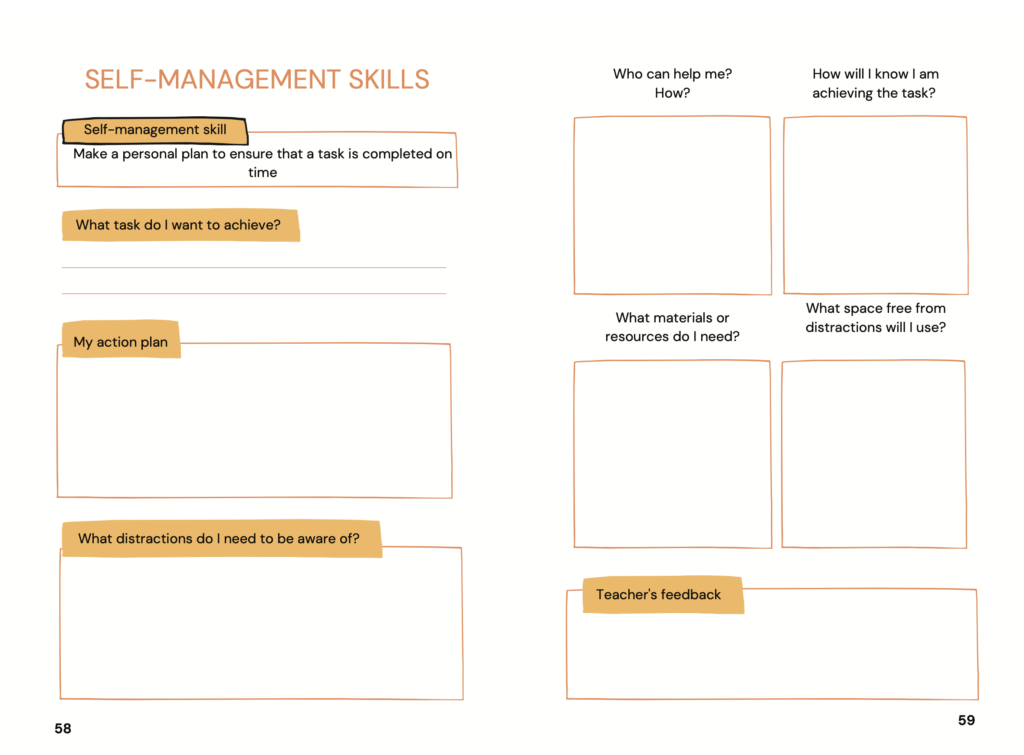
For example, when teaching self-management and organisation, many teachers assume students know how to plan tasks independently. However, students are rarely taught:
- how to break complex tasks into manageable steps
- how to prioritise responsibilities
- how to estimate time realistically
- how to monitor progress during learning
In the book, one strategy encourages students to use structured planning and self-monitoring tools before, during, and after a task. Rather than simply asking students to “be organised,” teachers guide learners to:
- identify the steps needed to complete a task
- anticipate possible challenges
- reflect on distractions and time management
- evaluate which strategies supported their success
Over time, students begin developing greater independence because the skill itself becomes visible and intentional rather than assumed.
Another example relates to reflection.
Reflection is frequently included in classroom routines, yet many students are not explicitly taught how to reflect meaningfully. As a result, responses often remain descriptive rather than analytical.
Through guided reflection prompts and metacognitive thinking routines included in the workbook, students learn how to:
- analyse their learning strategies
- identify areas of growth
- make connections between effort and outcomes
- set realistic goals for improvement
This shifts reflection from a compliance activity into a genuine learning process that strengthens self-regulation and ownership.
Skills Development Requires a Whole-School Vision
While individual classroom practices matter greatly, sustainable skills development cannot depend on isolated teacher initiatives alone.
For students to experience meaningful growth, schools need a coherent and developmentally aligned approach to skills across all stages of learning.
When schools intentionally create a shared vision for skills development:
- teachers gain greater clarity and consistency
- learning experiences become more connected
- students encounter common language and expectations
- agency becomes more visible in everyday classroom practice
Skills cannot be left to chance or treated as an “extra” alongside content learning.
They need to be embedded intentionally within curriculum, pedagogy, assessment, and reflection in ways that are developmentally appropriate and sustainable over time.
Teaching Students How to Learn
These conversations are often associated with IB education, inquiry learning, or future-focused frameworks, but the reality is that they are relevant across all educational systems and contexts.
Regardless of curriculum or country, schools are increasingly asking the same questions:
How do we develop learners who are independent, reflective, adaptable, and capable of navigating complexity?
Teaching content matters deeply.
But teaching students how to learn may be one of the most important responsibilities schools have today.
This is one of the reasons why Empowering Future Skills: A Practical Reflection Workbook for Educators was created: to support educators in moving beyond talking about skills and toward making skills visible, intentional, and actionable in everyday classroom practice.
The book includes:
- practical strategies for explicit skills instruction
- reflection and metacognitive routines
- self-monitoring tools for learners
- classroom-ready ideas that support student agency and engagement
- opportunities for students to develop greater ownership of their learning process
When skills are taught intentionally, students do not simply complete learning tasks more successfully.
They begin to understand themselves as learners.